miércoles, 10 de febrero de 2016
Review: Tactimania - Flear
Title: Tactimania
Author: Glenn Flear.
Publisher: Quality Chess.
Year: 2011.
Pages: 264.
Price: 21.99€.
Here I have another oldie for you. This book, as the name suggests, is a book about tactics. It contains around 450 tactical exercises from the praxis of Glenn Flear and his wife. It is a family work, as the illustrations come from their son.
The book contains 13 chapters, eleven of them dealing with some theme (from mates to trying to save lost positions), while the last two are tests of around 20 positions each. Those two last chapters have their solution in the next page too, as the whole book, but they are called test because you get to score points and see at what level you are at.
This book is quite hard to make sense of. It is littered with drawings one would assume target a kids' audience, but the exercises can get quite difficult. When I picked up this book I thought I would use it as Weteschnik Tactics from scratch, as a way to warm up, but that is not so, I was unable to solve some problems with one star (it has only three levels of difficulty).
The length of the book at 264 pages is ok, but some of the pages have drawings, so you actually get less chess than that. To compare, while this book contains 450 exercises, Weteschnik packs 300 (easier) and Quality Chess Puzzle Book (I hope to review it sometime, when I manage to finish it) packs more than 700 (harder).
The solutions are normally correct, sometimes mirroring the computer line exactly even if it does not make sense from a human point of view. In those cases I would have loved to have more depth, because I was left wondering where all those moves came to be and had to put the position in the computer to understand them. On the other hand, some problems have duals solutions which are not contemplated, or even wrong solutions according to my computer. They are not many, but they exists.
You should know by now that wrong solutions annoy me a lot, because I get the feeling that each time I fail an exercise I need to check it against the computer to ensure my solution is not flawed. But that is not what defined this work for me.
For me the drawings are terrible, but I think it is a taste thing, and you can do like I did and just ignore them. So that is not what defined this work either.
The most striking feature of this book is the choosing of the exercises. Flear put into himself the task of finding tactical exercises in his and his wifes' games, and came up with a very strange collection.
While I was reading the book, I never got the hang of it. In normal books you start looking at sacrifices and such, normally that is what works in those. But here, as the number of games was so low, some very untypical examples managed to make it to the book.
That is a good thing in the sense that you have to shift your way of thinking, but if you are anything like me, you will get annoyed at some exercises.
All in all I cannot recommend this book. I do not like the drawings, nor I feel the exercises are well selected (although I told you already that is a good thing!, but I do not like it). It does not have that many exercises, so that is not a point for it either. At the end of the day, there are better books to choose from.
Lastly, if you decide to go for the book, I can tell you about chapter 12, which has the first test. I went to solve the 19 exercises in it in two hours with a friend of mine rated approximately like me (2200). We had to photocopy the problems as the solutions were intermixed with them, and we wrote down our solutions. The final result was that we classified both as tournament players (with a very similar score), which is lower than international players, IM and GM. I felt that two hours was very little time to solve all the exercises.
jueves, 31 de diciembre de 2015
Review: Positional Decision Making in Chess by Gelfand
Title: Positional Decision Making in Chess.
Author: Boris Gelfand.
Publisher: Quality Chess.
Year: 2015.
Pages: 285.
Price: 29.99€ (hardback).
This review has been a hard one to make. I have had this book for half a year now, and I have not been able to finish it. I am at page 255, though! The reason is that I do not like the book, at least not when I try to work hard on it. I will explain it more in what follows, but first, let me state some obvious fact: The immense majority of the chess community (and I may be the lone exception) loves this book.
For example, John Hartmann, the English Chess Federation which voted it the best book of 2015, Emil Sutovsky or Peter Svidler, to name just a few. If you go to its publisher's page, you will find a long list of praising reviews.
What is wrong with me then? Well, I will try to explain myself as well as I can. I have done an auxiliary post on what I like in books, which will help put my reasoning into context, but I will try to make this review as self contained as possible.
The book is written by Gelfand and Aagaard. Gelfand has put the chess knowledge, and Aagaard the how to write knowledge. It has been done through conversations from the authors, Aagaard asking questions trying to get as much knowledge as possible out of Gelfand. The book consists of annotated games from Rubinstein and Gelfand.
It is part of a series of books (as of this moment it is unknown how many more it will be), and this one concentrates, as the name suggests, on how to take positional decisions at the board.
The book is divided into five chapters plus an interview from 2012. Each chapter deals with a topic: Rubinstein, The squeeze, Space advantage, Transformation of pawn structures and Transformation of advantages.
While reading the book I never got the impression that an overall idea in the book, or in each chapter, existed. For me it transpired too much that the book was a product of conversations rather than someone's grand design. Gelfand will not try to make a systematic review of the topic at hand, but will show you some examples that he finds interesting, and in its games he will try to explain his thought process.
The edition of the book, at least its hard cover, is excellent. I do not know why I even continue to comment on that in Quality Chess products, because it is always like this. The length is quite okay at nearly 300 pages, but it feels a thin book nevertheless, or at least that was the impression I've got when I unpacked the book. It may be the hard cover that is so thick that make the rest of the book, by contrast, look thin, but nevertheless you cannot argue with the raw facts: the book is in the medium range, it is not short, nor is it long.
The prose of the book is uneven. I have think long and hard how best to describe it, and that is the word I came up with.
The first chapters find the language somewhat redundant, with some odd choices here and there. Those passages make you feel that you are truly in a conversation with Gelfand. Aagaard stated that the language was chosen carefully, so my only conclusion is that this was the purpose of the book. I, however, do not like it too much. Other chapters, the later ones, are more normal, which I liked best.
But the feeling that the book jumps from one place to another as if it were a real conversation is there all the way through, and it gives you the feeling of a not too well thought work.
On the other hand, the prose is really generous! You do not normally find books with so much literature in it, and specially in the middle of the game. There are 34 games in 260 pages (not counting the interview), so you get 7 pages of commentary for each game! That is quite a lot and I think it is a really great decision.
The analysis in the book is uneven too. Rubinstein's games are normally annotated lightly, but Rubinstein - Alekhine, Karlsbad 1911 got 9 pages. I have found this game annotated in two previous works, Shereshevsky's Endgame Strategy and Marin's Learn from the legends. I do not think that Gelfand has done a better job than Marin, and I felt that he was not building up, but doing the work from the ground.
On the other hand, Gelfand's games have generally detailed analysis, and more importantly, big
So, let's wrap it up:
The key factor of this book is that offers you great insight on the thinking process of a great player. The prose is great, and although I do not like some redundancies here and there, the general feeling is that the book is really well written.
I can see how Svidler and Sutovsky liked the book: They do not expect to learn anything from normal books, so this at least gives them some interesting insight into other super GM mind.
And I can see how normal people like me cherish this book greatly. The book is, after all, a masterpiece, so what is not to like about it?
Well, first of all, for me it is a bit odd that the book is called 'Positional decision making in chess'. A name like 'My best games by Genfald' would suit it far better. As the book tries in no way to explain a theme but only shows you examples, it is better to see it as just a collection of games selected by diffuse criteria.
We have to assume, too, that there are games sparsely annotated. I liked those quite less, but that is a personal opinion. On the other hand, the ones heavily annotated for me were difficult to study. Something in them was amiss, or maybe it is me, I do not know.
But my main concern with the book is not these things. The main problem for me is that while giving you great insight of the mind of a great player, it will not improve your overall chess. Yes, you will enjoy reading the book immensely, you will come to realize of quite a number of interesting things, but at the end of the day, when Gelfand says that in certain positions he is interested in improving the position more than in the objective evaluation of the position, that will not improve your chess one bit. The amount of advice directly applicable to your games is slim. Of course, if you study the games in detail, it will improve your chess, but do the people making the good reviews have done so? I know I have not been able to...
It saddened me when the English Chess Federation chose this book over Mauricio Flores' Chess Structures. I think Flores' work to be so much better in almost every way, except in giving this great insight that is not useful in a real game. Flores has written a masterpiece, one that future generations ought to remember as high as My System by Nimzowitch, while Gelfand has written a very entertaining book to read, accessible to every level of play, but ultimately of limited use to improve your chess.
So now comes the stupid thing of this review: I do not recommend this book, there are a lot of books out there that will help you with your chess a lot more. I have reviewed some here, and I will continue to do so. But I surely not regret one bit having bought it, and I will for sure buy the next one. It is true that the book will not improve your chess, but it is a great book, entertaining and insightful, and it does have some small nuggets of true wisdom, so all in all, there is no need to have always perfect books to study, you may as well indulge yourself in some lighter reading once in a while!
Addendum:
Jacob Aagaard took the time to respond to this review. I will paste it unedited, but you can click here and read it in the original page.
Now to move on to your review and answering some of the questions it raises. If you want, you are very welcome to add this to your review on your site. If you don’t want to, don’t. Our blog is an open forum; your website is promoting your views.
There are some claims that are not true in my opinion, and as I structured the book, I feel my opinion counts.
A big claim is that there is no overall structure to the book and that this is just loose conversations collected in some haphazard way.
We spent quite a bit of time structuring the book at the beginning and to give a coherent look into Boris’ way of thinking and approach. We did not want this to be a manual in the sense that it had to cover all elements or in some way give a complete picture of the topic of positional chess. There are other books trying to do this, in different ways and they are more or less all valuable. What I wanted to do with this book was to explain how Boris, one of the greatest strategists of his generation if not of all time. I wanted to explain the basis of his decisions, which (besides calculation, which we will debate in the next book) are mainly surrounded around the five topics we discuss in the book.
The overall idea for the book: Positional Decision Making in Chess. It is about decision making, looking into the brain of a top player. What is interesting is not only what he uses as a basis for his decisions, but also what he ignores. Looking through the book now, it seems perfectly nicely structured to me, as does the chapters. Each chapter brings in a topic of special relevance, shows the influence from Rubinstein (and others) and then moving into more and more complicated games from Boris.
I am happy the book feels chatty. I wanted it to. It took a lot of work squeezing it out of Boris!
Uneven analysis of the games you say. I assume you mean uneven in length. Yes, some things were more interesting than others. However, the way you have written it, it seems you are criticism the level of the analysis, which I do not think was your intention. In the same way you use the word “junks” instead of “chunks”, which is a bit unfortunate.
Redundancies as a stylistic tool: Yes, we are consciously using this, with the intention of creating lasting improvement. Telling people something once and then moving one does not have that effect.
Comparison with Marin. Which edition did you compare with? The new edition of Legends was heavily influenced by my deep analysis, which was done first and only then compared with Marin’s. Actually it took some effort to explain Marin where he was wrong in the first book .
Yes, the explanations are different; the purpose of our annotations is to show what Boris took from it. I can understand why this is not a viewpoint that will interest everyone, but I certainly found it the most fascinating. I am interested in how strong players think and showing that. And this is what we did.
Size of the book. There are a few elements that can make you feel the way you do: Our paper is of higher quality than for example the paper from all other publishers as far as I can tell. A 400 page book by QC will be slimmer than a 224 page book from a number of other publishers. In general books from Quality Chess are longer than those of most other publishers (MacFarland and Chess Informant are exceptions, but not direct comparisons). This is not by choice, but because we often employ authors who have a lot to say, rather than wanting to have the highest hourly rate. And yes, this is certainly by choice. (Obviously Boris had a lot to say and did say a lot, but there are less chess moves in the book, as you pointed out, and as such, also less diagrams).
The final reason for you not liking the book is where we come down to opinion and disagreement the most. You say that the book does not lead to improvement. There are a number of areas where we can improve. Exercise books, opening books, encyclopedias like Chess Structures offer different ways. But famous trainers like Dvoretsky have always suggested that you should play through game collections with the annotations from strong players, to see how they think and see if it in any way can improve your own thinking. This book was meant to emphasize the thinking part of this, rather than the best games aspect. And the feedback we have had is that it indeed leads to improvement, as I expected it to.
Having argued against all these points, there is one I definitely do not want to argue against. You clearly did not like the book. Of course I am sad that you were disappointed. But I have not yet seen a book that everyone liked, so I can live with it.
What I like in books, my personal biases
When you review a book, you do that through your personal biases, after all, everybody has its own tastes, and you cannot put those aside to make an unbiased assessment. You may try it, yes, but you will never fully succeed.
So I want to state clearly what I search in books. This way you will know to put my reviews in context.
For me chess books are a source of joy (as I hope happens for you too). I have been reading chess books from more than twenty years now and one can say that I have a very classical library.
The main problem I came to realize was that I have been reading chess books 'incorrectly', only for the joy. I've read the text, but never truly stopped to think about the moves or the position. So at the end of the day, while I had a wonderful time reading those classical books, my chess level has not improved because I have not done any real work on it.
I have been trying to improve my chess for a year and a half now. In my quest to achieve this, my way of appreciating books have changed. Now I need to study seriously a book, because now I want to improve too, not only enjoy the reading. So now the attention has shifted from 'is the book well written' to 'will the book improve my chess'.
And how do you evaluate if a book improves your chess? Well, for me the easiest metric would be (elo points gained / book), but it turns out it is quite difficult to measure that, both because a book will not so dramatically improve your chess, and because the improvement is a continuous process over time, and it is quite difficult to discern the causes over long periods.
The second metric I like to put forward is (time spent thinking / book). It stands to reason that the more time you put studying chess, the higher the improvement you will experience.
When you use the (time spent thinking / book) metric to evaluate a book the first thing you notice is that exercise books are heavily favored. That's because one has to spend time thinking about the exercise to solve it, and it takes so few space in print that you can have quite a huge number of exercises. Think for example on QC puzzle book with 725 exercises, or the new book by Dvoretsky 'Recognizing Your Opponent's Resources'. Obviously it is not only about the number of exercises, as you have to find them entertaining, at your level, and they have to offer quality solutions, and I will take that into account, but overall, yes, these books are favored.
Books that try to explain some deeper knowledge, however, are heavily disfavored. They show a handful of examples and spend a lot of time on literature (or variations in the examples), but do not force you to think over the example, they require you to on your own be disciplined and don't rush through the examples to be able to read more of the literature.
I have to confess that I'm quite bad at not rushing through the examples. I do not know if it is a common thing, but I'm yet to know someone who is not afflicted by this at some level. So for this type of books the important thing is: do the author makes a good job of preventing me from rushing to the end of the book?
There are some tools at the author disposal. To find compelling examples and ask the reader to pause and think for a moment are two of those, but there is no clear and sure path. There lies the difficulty.
I may be a lone traveler on this boat, though, as I often find that other reviewers will rate books on how entertaining they are, instead of their instructional value. Or maybe rate them on its instructional value on the surface... maybe the book seems very instructional, it may provide clear rules and thorough examples, but when you try to study it you simply cannot do it and the book and its instructions will never transpire in your games.
In my reviews, I will always try to be very critique about this, I will always ponder if I have been able to really work on the book or not. Of course, this will always be a personal thing. Maybe what works for me won't work for you, but I will always (specially in bad reviews) try to explain my point of view.
So here you have my dissonant voice, I hope you enjoy it as much as I enjoy writing this pieces.
So I want to state clearly what I search in books. This way you will know to put my reviews in context.
For me chess books are a source of joy (as I hope happens for you too). I have been reading chess books from more than twenty years now and one can say that I have a very classical library.
The main problem I came to realize was that I have been reading chess books 'incorrectly', only for the joy. I've read the text, but never truly stopped to think about the moves or the position. So at the end of the day, while I had a wonderful time reading those classical books, my chess level has not improved because I have not done any real work on it.
I have been trying to improve my chess for a year and a half now. In my quest to achieve this, my way of appreciating books have changed. Now I need to study seriously a book, because now I want to improve too, not only enjoy the reading. So now the attention has shifted from 'is the book well written' to 'will the book improve my chess'.
And how do you evaluate if a book improves your chess? Well, for me the easiest metric would be (elo points gained / book), but it turns out it is quite difficult to measure that, both because a book will not so dramatically improve your chess, and because the improvement is a continuous process over time, and it is quite difficult to discern the causes over long periods.
The second metric I like to put forward is (time spent thinking / book). It stands to reason that the more time you put studying chess, the higher the improvement you will experience.
When you use the (time spent thinking / book) metric to evaluate a book the first thing you notice is that exercise books are heavily favored. That's because one has to spend time thinking about the exercise to solve it, and it takes so few space in print that you can have quite a huge number of exercises. Think for example on QC puzzle book with 725 exercises, or the new book by Dvoretsky 'Recognizing Your Opponent's Resources'. Obviously it is not only about the number of exercises, as you have to find them entertaining, at your level, and they have to offer quality solutions, and I will take that into account, but overall, yes, these books are favored.
Books that try to explain some deeper knowledge, however, are heavily disfavored. They show a handful of examples and spend a lot of time on literature (or variations in the examples), but do not force you to think over the example, they require you to on your own be disciplined and don't rush through the examples to be able to read more of the literature.
I have to confess that I'm quite bad at not rushing through the examples. I do not know if it is a common thing, but I'm yet to know someone who is not afflicted by this at some level. So for this type of books the important thing is: do the author makes a good job of preventing me from rushing to the end of the book?
There are some tools at the author disposal. To find compelling examples and ask the reader to pause and think for a moment are two of those, but there is no clear and sure path. There lies the difficulty.
I may be a lone traveler on this boat, though, as I often find that other reviewers will rate books on how entertaining they are, instead of their instructional value. Or maybe rate them on its instructional value on the surface... maybe the book seems very instructional, it may provide clear rules and thorough examples, but when you try to study it you simply cannot do it and the book and its instructions will never transpire in your games.
In my reviews, I will always try to be very critique about this, I will always ponder if I have been able to really work on the book or not. Of course, this will always be a personal thing. Maybe what works for me won't work for you, but I will always (specially in bad reviews) try to explain my point of view.
So here you have my dissonant voice, I hope you enjoy it as much as I enjoy writing this pieces.
Reviewing books you don't like
It has been long since I posted a review. The main reason for it is that it has reached a point that many of the books I have interest in reviewing I have already done so. Now I more or less depend on what I read to make new reviews, and the process is obviously slower.
But on the other hand, there is another reason that I have just come to realize. It turns out my reviews are greatly biased towards books I've liked.
I do this on my free time, I do not get the books for free from the publisher, so I have no pressure to make good reviews, but there are some unexpected (for me) barriers that make the task of making bad reviews harder.
The obvious reason is that making bad reviews you are hurting someone else's feelings, and it is not very pleasant. Every book I'll review will have tons of work and love put into it after all.
On the other hand, there is a deeper reason: You usually don't read the books you don't like, and for me it is very difficult to review books I have not finished (or studied seriously).
Maybe I have an oversized sense of honesty, but it feels wrong to make a bad review of something you have not fully read.
Anyways, this turns out to be a disservice to my readers (as few as you may be). My main objective for writing this was to offer another point of view so someone searching for a book would make an informed decision, and the fact that I did not liked a book may be as compelling as the fact that I liked one.
In the future I'll try to improve on this things, and I will start making two 'bad' reviews. However, be aware that I will have yet another bias: I will only notice bad books from usually good publishers or hyped titles. Of course it will never cross my mind spend money on books I suspect before hand that do not deserve my money. So keep that in mind.
But on the other hand, there is another reason that I have just come to realize. It turns out my reviews are greatly biased towards books I've liked.
I do this on my free time, I do not get the books for free from the publisher, so I have no pressure to make good reviews, but there are some unexpected (for me) barriers that make the task of making bad reviews harder.
The obvious reason is that making bad reviews you are hurting someone else's feelings, and it is not very pleasant. Every book I'll review will have tons of work and love put into it after all.
On the other hand, there is a deeper reason: You usually don't read the books you don't like, and for me it is very difficult to review books I have not finished (or studied seriously).
Maybe I have an oversized sense of honesty, but it feels wrong to make a bad review of something you have not fully read.
Anyways, this turns out to be a disservice to my readers (as few as you may be). My main objective for writing this was to offer another point of view so someone searching for a book would make an informed decision, and the fact that I did not liked a book may be as compelling as the fact that I liked one.
In the future I'll try to improve on this things, and I will start making two 'bad' reviews. However, be aware that I will have yet another bias: I will only notice bad books from usually good publishers or hyped titles. Of course it will never cross my mind spend money on books I suspect before hand that do not deserve my money. So keep that in mind.
lunes, 19 de octubre de 2015
Review: Mating the Castled King by Gormally
Title: Mating the Castled King.
Author: Danni Gormally.
Publisher: Quality Chess.
Year: 2014.
Pages: 336.
Price: 22,99€.
These days I have been taking my sweet time in creating this posts. There is a big reason for that: I have been exhausting those books I have already read and find interesting. I have some yet, do not worry, but sooner rather than later I will run out and my only possibility would be to make a review with the new books I read.
Luckily, I have a long list of books waiting to be read (including Gelfand's book!) and some of them are closer to the finish line than others (I cannot focus on one book at a time).
Mating the Castled King is one that I just recently finished. As the tittle suggest, it is a guide to attacking chess, similar to The attacking Manual by Aagaard which hopefully I will be reviewing soon. I am not an attacking player, I have never been, so all the stuff explained seemed very exotic to me, but very inspiring too!
This book has a curious structure. It has a second chapter with 160 exercises on combinations against the king while the rest of it (except a small test at the end of the book with 12 positions) is like a normal book where it gives you examples showing what the text is trying to argue (for example that sacrificing a bishop on h6 might be a good idea). I like this mix quite a lot, it forces you to solve problems (lots of them) and also tries to bring some good examples home.
Another sweet point for the book is that almost all the examples given in the text (or in the puzzles) were unknown to me.
About the edition of the book there is not much to say. The quality of this publisher is outstanding as it has always been and I have not found anything troublesome in it. I have even grown to be fond of this green cover which I disliked at first. The length of the book is quite all right, more over when you know a little part of it has tons of exercises.
The explanations to the attacking themes are correct. Maybe I did not found myself too much impressed by them, but what do you want? The themes themselves where kind of obvious for me. The exemplary games on the other hand I think were skilfully chosen and most often than not where downright impressive (ok, I am a novice attacker, but nevertheless). That was what I lacked. I know perfectly well that Rxf6 is very dangerous, so it is Bxh7 or playing h2-h4-h5-h6, but selecting the right examples, the more spectacular ones, or seeing how you chain sacrifices is what caught me.
I think Gormally hit a sweet spot when trying to balance how many variations to introduce in the text. Maybe in some examples it had less than I wanted them to be, but overall it has everything you need without drowning you in variations.
My conclusion about the book is very positive. I think that Gormally has made a great job with this book and players below 2300 fide will find it very interesting. I do not want to spoil other reviews for you, but if I were to buy one book on attacking chess, at the moment this would be it.
domingo, 4 de octubre de 2015
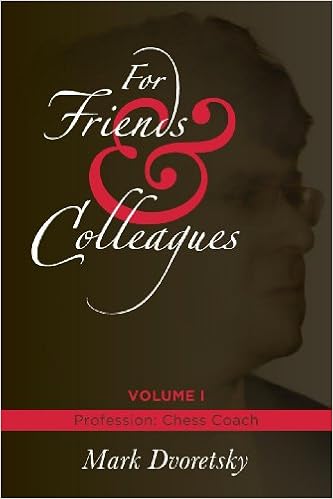
Review: For Friends and Colleagues volume 1 by Dvoretsky
Title: For Friends and Colleagues Volume 1. Profession: Chess Coach.
Author: Mark Dvoretsky.
Publisher: Russell Enterprises.
Year: 2014.
Pages: 384.
Price: 30$.
This is the first volume of Dvoretsky's autobiography. I put that last word in italics because it is not your run of the mill biography, the author has restricted himself to tell his life only when related to chess. I think that is a great idea. What I'm interested in is Dvoretsky the chess player and trainer, not the son, husband or father.
One thing that I want to get out of the way fast is that this is not a book to train chess. Even if there are commented games and diagrams, those are auxiliary parts. The focus on the book is to tell a story, Dvoretsky's story. If you want to improve your chess, go search elsewhere.
To me this was a very interesting book. You get to know more about the soviet times and about some great figures of the game. However the book seems like a collection of little works put together. There are some parts of it that are a direct rip of already published material, but I couldn't shake the feeling even in those parts where no mention of a previous print was made, that was actually what happened.
Maybe because of this, the best word to describe the book is uneven. There are some really great parts, when I couldn't stop readying. On the other hand, some parts where plain boring. I felt it specially at the end, but through the book there are always passages like that.
Other than that, there is a small detail that I did not like: According to the book, Dvoretsky was never wrong. Whenever someone else in the book is portrayed as having a different opinion than that of the author, the inevitable conclusion will be that he was wrong and the author was right all along. There are passages where this someone came back to the author apologizing and Mark graciously accepted the apologies and resumed the work together.
As I see it, everyone makes mistakes. It is not possible for the author to never be wrong. So there are only two options left: Or he has discretely hide his own shortcomings, which maybe is a legitimate thing to do being this his book, or in at least some of his stories the truth is not entirely told.
I would line with the first option, because Dvoretsky (as portrayed by himself) seems to be a person with ideals and integrity, incapable of changing the facts to fit the vision of oneself. I would even go as far as to think that it was not intentional. But nevertheless it is there, and it annoyed me!
All in all, I think it is a good book, and if you have 12€ lying around, I would advice you to buy the kindle version of the book. It is half the price, and the book itself is not that great to justify having it physically.
Review: GM Preparation - Positional Play by Jacob Aagaard
Title: Grandmaster Preparation - Positional Play.
Author: Jacob Aagaard.
Publisher: Quality Chess.
Year: 2012.
Pages: 312.
Price: 24.99€.
This book is a part of a 6 title collection. Each one deals with a specific topic through some introductory prose and tons of exercises. The objective is to give people aspiring to be Grand Masters (or already GMs wanting to stay sharp) training material. The one being reviewed is centered in positional play.
I must confess that I'm in love with workbooks. I am a very lazy person and if given a book where I only need to read and nod, I will just do that. On the other hand, with this book there is not much more to do but to solve exercises so at least you will put some work on it.
The book is divided into three chapters: Weaknesses, Pieces and Prophylaxis. Each chapter has a short introduction and afterwards some exercises on the theme described. There is also a very big chapter at the end with 150 exercises.
For me the thematic division helps to a certain extend. In the 'Pieces' chapter you will try to improve one of your pieces and in the 'Prophylaxis' chapter you will try to ruin your opponents plan. However it is quite difficult to have a clearcut division, so in some exercises you will not really get a help for knowing the chapter it is in.
Anyway it is not such a problem, and the last chapter is the heaviest of them all, and there the author does not try to classify the position into themes, but let you alone with your positional understanding.
While reading the book I didn't get the feeling that the solutions where wrong, hence I don't think I let my engine do its magic. I guess that some of the positions don't have a clear answer and maybe the engine propose a better solution, but all in all the impression is that Aagaard checked them himself so no egregious mistake happened.
At more than two hundred exercises the book is packed. Assuming you spend 5 minutes per position, you will have more than 15 hours of quality chess for only 25€. I think that is a pretty good deal, even if the book itself is not on the cheap side.
The only negative thing I can point out is that its audience is not as the book suggest IMs wanting to make to the next level. While working on the book I let myself 25 minutes on the clock for each page of 6 diagrams. That is less time than the author suggests, but nevertheless usually I got 3 or 4 diagrams right out of the 6. So in my view I have the perfect strength to enjoy the book: being able to barely solve the problems if working hard on them. As I'm 2200 elo myself, I don't think many strong IMs will have much difficulty with it.
On the other hand, this is good news for the mere mortals: we can enjoy this great work even at our pity strength!
My suggestion would be: Go download the excerpt. There are 6 problems with its solution, let yourself half an hour of thinking time to solve them. Check the solutions. If you got between 2 and 4 right, you definitively have to get this book. With less than 2 problems solved you may want to go elsewhere, It can get really frustrating not to solve anything, and you are not really improving if the level of the exercises is so far beyond yours. Fortunately, if this is your case, in this very same publishing house there is something for you too: Yusupov great work!
If you were to solve more than 4 exercises out of 6, maybe you are already too strong for the book, but I let you decide by yourself. If you reached that level of chess you know what you are doing.
Suscribirse a:
Entradas (Atom)