lunes, 19 de octubre de 2015
Review: Mating the Castled King by Gormally
Title: Mating the Castled King.
Author: Danni Gormally.
Publisher: Quality Chess.
Year: 2014.
Pages: 336.
Price: 22,99€.
These days I have been taking my sweet time in creating this posts. There is a big reason for that: I have been exhausting those books I have already read and find interesting. I have some yet, do not worry, but sooner rather than later I will run out and my only possibility would be to make a review with the new books I read.
Luckily, I have a long list of books waiting to be read (including Gelfand's book!) and some of them are closer to the finish line than others (I cannot focus on one book at a time).
Mating the Castled King is one that I just recently finished. As the tittle suggest, it is a guide to attacking chess, similar to The attacking Manual by Aagaard which hopefully I will be reviewing soon. I am not an attacking player, I have never been, so all the stuff explained seemed very exotic to me, but very inspiring too!
This book has a curious structure. It has a second chapter with 160 exercises on combinations against the king while the rest of it (except a small test at the end of the book with 12 positions) is like a normal book where it gives you examples showing what the text is trying to argue (for example that sacrificing a bishop on h6 might be a good idea). I like this mix quite a lot, it forces you to solve problems (lots of them) and also tries to bring some good examples home.
Another sweet point for the book is that almost all the examples given in the text (or in the puzzles) were unknown to me.
About the edition of the book there is not much to say. The quality of this publisher is outstanding as it has always been and I have not found anything troublesome in it. I have even grown to be fond of this green cover which I disliked at first. The length of the book is quite all right, more over when you know a little part of it has tons of exercises.
The explanations to the attacking themes are correct. Maybe I did not found myself too much impressed by them, but what do you want? The themes themselves where kind of obvious for me. The exemplary games on the other hand I think were skilfully chosen and most often than not where downright impressive (ok, I am a novice attacker, but nevertheless). That was what I lacked. I know perfectly well that Rxf6 is very dangerous, so it is Bxh7 or playing h2-h4-h5-h6, but selecting the right examples, the more spectacular ones, or seeing how you chain sacrifices is what caught me.
I think Gormally hit a sweet spot when trying to balance how many variations to introduce in the text. Maybe in some examples it had less than I wanted them to be, but overall it has everything you need without drowning you in variations.
My conclusion about the book is very positive. I think that Gormally has made a great job with this book and players below 2300 fide will find it very interesting. I do not want to spoil other reviews for you, but if I were to buy one book on attacking chess, at the moment this would be it.
domingo, 4 de octubre de 2015
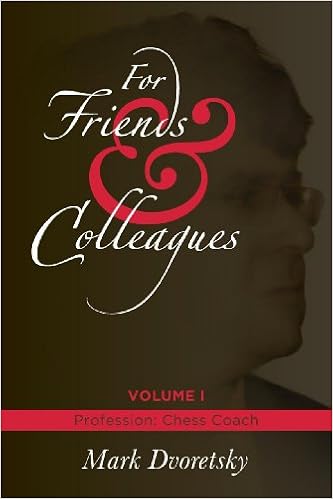
Review: For Friends and Colleagues volume 1 by Dvoretsky
Title: For Friends and Colleagues Volume 1. Profession: Chess Coach.
Author: Mark Dvoretsky.
Publisher: Russell Enterprises.
Year: 2014.
Pages: 384.
Price: 30$.
This is the first volume of Dvoretsky's autobiography. I put that last word in italics because it is not your run of the mill biography, the author has restricted himself to tell his life only when related to chess. I think that is a great idea. What I'm interested in is Dvoretsky the chess player and trainer, not the son, husband or father.
One thing that I want to get out of the way fast is that this is not a book to train chess. Even if there are commented games and diagrams, those are auxiliary parts. The focus on the book is to tell a story, Dvoretsky's story. If you want to improve your chess, go search elsewhere.
To me this was a very interesting book. You get to know more about the soviet times and about some great figures of the game. However the book seems like a collection of little works put together. There are some parts of it that are a direct rip of already published material, but I couldn't shake the feeling even in those parts where no mention of a previous print was made, that was actually what happened.
Maybe because of this, the best word to describe the book is uneven. There are some really great parts, when I couldn't stop readying. On the other hand, some parts where plain boring. I felt it specially at the end, but through the book there are always passages like that.
Other than that, there is a small detail that I did not like: According to the book, Dvoretsky was never wrong. Whenever someone else in the book is portrayed as having a different opinion than that of the author, the inevitable conclusion will be that he was wrong and the author was right all along. There are passages where this someone came back to the author apologizing and Mark graciously accepted the apologies and resumed the work together.
As I see it, everyone makes mistakes. It is not possible for the author to never be wrong. So there are only two options left: Or he has discretely hide his own shortcomings, which maybe is a legitimate thing to do being this his book, or in at least some of his stories the truth is not entirely told.
I would line with the first option, because Dvoretsky (as portrayed by himself) seems to be a person with ideals and integrity, incapable of changing the facts to fit the vision of oneself. I would even go as far as to think that it was not intentional. But nevertheless it is there, and it annoyed me!
All in all, I think it is a good book, and if you have 12€ lying around, I would advice you to buy the kindle version of the book. It is half the price, and the book itself is not that great to justify having it physically.
Review: GM Preparation - Positional Play by Jacob Aagaard
Title: Grandmaster Preparation - Positional Play.
Author: Jacob Aagaard.
Publisher: Quality Chess.
Year: 2012.
Pages: 312.
Price: 24.99€.
This book is a part of a 6 title collection. Each one deals with a specific topic through some introductory prose and tons of exercises. The objective is to give people aspiring to be Grand Masters (or already GMs wanting to stay sharp) training material. The one being reviewed is centered in positional play.
I must confess that I'm in love with workbooks. I am a very lazy person and if given a book where I only need to read and nod, I will just do that. On the other hand, with this book there is not much more to do but to solve exercises so at least you will put some work on it.
The book is divided into three chapters: Weaknesses, Pieces and Prophylaxis. Each chapter has a short introduction and afterwards some exercises on the theme described. There is also a very big chapter at the end with 150 exercises.
For me the thematic division helps to a certain extend. In the 'Pieces' chapter you will try to improve one of your pieces and in the 'Prophylaxis' chapter you will try to ruin your opponents plan. However it is quite difficult to have a clearcut division, so in some exercises you will not really get a help for knowing the chapter it is in.
Anyway it is not such a problem, and the last chapter is the heaviest of them all, and there the author does not try to classify the position into themes, but let you alone with your positional understanding.
While reading the book I didn't get the feeling that the solutions where wrong, hence I don't think I let my engine do its magic. I guess that some of the positions don't have a clear answer and maybe the engine propose a better solution, but all in all the impression is that Aagaard checked them himself so no egregious mistake happened.
At more than two hundred exercises the book is packed. Assuming you spend 5 minutes per position, you will have more than 15 hours of quality chess for only 25€. I think that is a pretty good deal, even if the book itself is not on the cheap side.
The only negative thing I can point out is that its audience is not as the book suggest IMs wanting to make to the next level. While working on the book I let myself 25 minutes on the clock for each page of 6 diagrams. That is less time than the author suggests, but nevertheless usually I got 3 or 4 diagrams right out of the 6. So in my view I have the perfect strength to enjoy the book: being able to barely solve the problems if working hard on them. As I'm 2200 elo myself, I don't think many strong IMs will have much difficulty with it.
On the other hand, this is good news for the mere mortals: we can enjoy this great work even at our pity strength!
My suggestion would be: Go download the excerpt. There are 6 problems with its solution, let yourself half an hour of thinking time to solve them. Check the solutions. If you got between 2 and 4 right, you definitively have to get this book. With less than 2 problems solved you may want to go elsewhere, It can get really frustrating not to solve anything, and you are not really improving if the level of the exercises is so far beyond yours. Fortunately, if this is your case, in this very same publishing house there is something for you too: Yusupov great work!
If you were to solve more than 4 exercises out of 6, maybe you are already too strong for the book, but I let you decide by yourself. If you reached that level of chess you know what you are doing.
domingo, 27 de septiembre de 2015
Review: Chess tactics from scratch, 2nd edition by Weteschnik
Title: Chess Tactics from Scratch - Understanding Chess Tactics 2nd Edition.
Author: Martin Weteschnik.
Publisher: Quality Chess.
Year: 2012.
Pages: 344.
Price: 22,5€.
There is not much to say in the presentation of this book that is not said in its tittle. The book's aim is to present tactics to novice audience. The author has make a great effort in presenting the root of many tactical themes in a very pedagogical way in the hope that with such a study the theme will be fixed in the readers mind.
For me it is difficult to judge if this is the right approach. My gut feeling tells me that tactical themes are best trained by solving hundreds of exercises on that theme, but I must confess that as a 2200 player I am not the primary target of the book. Maybe lower levels do need this explanatory prose.
The books is divided in chapters each one explaining a tactical theme, and a final chapter with a collection of exercises (which comprises one third of the book) on those themes. As far as I know, the last chapter (and hence 1/3 of the book) is a new addition of the 2nd edition, while the rest of the book has been heavily revised.
The edition is on par with other Quality Chess books, excellent, and the length in the second edition is as I have come to expect with more than 300 pages, so you are getting a lot of pages for your money.
I have not much to say from the first 2/3rds of the book. I started reading it but soon found that my level was considerably higher than the material exposed, hence I was tempted to leave the book alone. However as it was a gift and it seemed wrong to not give it another try, I browsed through the exercises expecting them to be easily solvable. To my surprise, although the books is aimed at novice audiences, it had some challenging problems and it took me a lot of effort to solve the difficult problems (if I was able to do so at all).
The solutions have little diagrams if there is an interesting position long in the variations, so you don't really need a board to follow it.
I went through the 300 exercises in about a month and usually the solutions where spot on (there are some problems when the proposed solution is not clear cut, but the computer agrees with Weteschnik, so what can I say?), which for me is important, with some older books you never know if the exercise is flawed and when you don't agree with the solution you usually have a nagging doubt in the back of your mind.
All in all I like this book a lot, I now use it to start training sessions, solving as much exercises as possible in 15 minutes. If you have <1800 elo points, I recommend this book to you wholeheartedly. If you are stronger, maybe you don't need it as much, and there are a lot of other good tactical books, but it will be a good purchase nevertheless. If you are 2300 or higher, go buy stronger puzzle books, as you have nothing to do here.
domingo, 30 de agosto de 2015
Review: Dvoretsky's Endgame manual (4th edition)
Title: Dvoretsky¡'s endgame manual.
Author: Mark Dvoretsky.
Publisher: Rushell Enterprises (Chessbase for the electronic version)
Year: 2015. (4th edition)
Pages: 424.
Price: 30€.
As the title may suggest, this is an endgame manual by the renowned author Mark Dvoretsky. In contrast with de la Villa's book 100 endgames you should know, this books tries to go deeper, giving you all the theoretical knowledge you would need as a professional player. In the introduction the author claims that for really strong players, such knowledge can be acquired in two weeks of work. This won't be the case for most of us, but luckily the book has a fallback plan. The book is written in two colors, blue font for those parts which Dvoretsky considers basic, and black font for those which we don¡'t need to know by heart (or even study the first time we pick up the book). In a way is like having de la Villa's book mixed with a more denser one. On the other hand, the blue font already reaches far more content than de la Villa's book in less space, so my recommendation of that book still stands.
Dvoretsky's endgame manual is divided in chapters, each one treating different kind of endgames depending on the material on the board. As reason dictates, however, not all the chapters have the same depth. The book starts out with pawn endgames (in contrast with de la Villa, which leaves this subject for much later in his book) with more than fifty pages but follows with some light chapters on minor pieces (or piece vs pawn). The other big part of the book, that of rook endgames, extends for nearly ninety daunting pages.
The edition is correct (I'm reviewing the fourth so far, so they had time to get it right). I have read some older reviews where the blue font was at times difficult to read because it was too dim. I have not had such problems.
The book has a lot of diagrams but I do not think you will be able to follow everything with that alone, endgame books are dense, and this may be even denser.
Although the book is expensive, you do get a long book in return at more than 400 pages, so I do not think you can feel cheated in any way (you can view it as two cheap books of 200 pages each).
The book, overall, is very readable, especially the basic parts in blue font. The explanations in those parts are as clear as possible and spot on. Obviously, endgames have lots of analysis and there are a lot of sections which are really hard to read, but keep in mind this book is aimed at professionals too. But if you limit yourself to the blue font, you will find it enjoyable and insightful.
On the other hand, if you go for the hard route and study all the material, I don't think you can complain either. There is some heavy analysis waiting for you too.
Before I make my recommendation, there is a point I want to clarify: I have not read the whole thing. I have studied the pawn endgame chapter profoundly from an earlier version and I have read (as carefully as a first read can be with this book, including black font) the rook endgame chapter. Other chapters I have just browsed rapidly if at all. As I plan to make a positive review, I do not feel it unjust that I have not read the whole thing to review it, but keep that in mind when you assess the validity of my work, maybe there are glaring holes in other chapters that I have not seen.
With that taken out of the way, let's go with the editorial part of the review:
I own an old electronic edition of the book from Chessbase (here is an article on the new edition) . The changes from that old version to this new one are almost negligible and in a normal case would not warrant buying it again, at least at my level of play, but maybe even at Carlsen level it makes no difference, as it is impossible to remember the analysis which have changed. So, why did I buy the new edition?
For me, this book is one which I will never read in full. I am the kind of person that enjoys endgames and have read multiple books on them, but my experience tells me that often you are blitzing the moves on the board just to finish the example at hand and you are not really assimilating the material.
Since those times, I try to be more careful in the way I approach endgame study. I try to go slower, and often reread the chapter I have studied (at least I read the pawn endgame chapter four times). At four hundred pages, this book will take a great toll in my limited free time if I were to read it following that advise.
Although I still cherish the idea of studying it in full, when I chose to buy myself this book for christmas I forced myself to accept that it was not because I wanted to study it. I already have the older edition in electronic format and I could never bring myself to study it in full. The real purpose was to have it in my library as a physical book, like a collector.
For me this book is a must have. You should buy it and treasure it in your library, knowing perfectly well that those 30€ you invest are not to improve your chess, but to fill a glaring hole you would have otherwise in your collection. If you are a disciplined student, you will at least read the blue font and mend some gaps in your endgame knowledge, but even if you can't get that, those 30€ would be well expended.
So yes, my recommendation is that you must definitively own this book.
The question of the format is open, though. I like the electronic version more for studying it. You need a board otherwise, and I'm lazy. But there is no discount on it, and you don't get the pleasure of smelling a new book, nor will it stand in your library mighty and dominant. That is why I own both! But I leave you both options open, choose whatever is best for you.
domingo, 9 de agosto de 2015
Review: Grandmaster chess strategy by Jürgen Kaufeld and Guido Kern
Title: Grandmaster chess strategy.
Author: Jürgen Kaufeld and Guido Kern.
Publisher: New in Chess.
Year: 2011.
Pages: 224.
Price: 22.95€.
Today it is time for another old book. As stated previously, it is my purpose with this blog to review the books I have read so someone else can benefit from my experience with them. Obviously the newer the book the more interesting will be the review for you, but older books still sell, hence there is a niche to cover, isn't it? So today I present to you a book from 2011.
Grandmaster chess strategy aims to teach chess through Ulf Andersson's games. Not in vain the subtitle of the book is What amateurs can learn from Ulf Anderson positional masterpieces. The book is divided in fifteen chapters covering some positional themes, like Playing against two weaknesses, Prophylaxis, The positional exchange sacrifice ... each chapter features a short introduction and some annotated games (around five for each chapter). A good addition to the book is that while annotating, the authors pose the reader questions which are answered immediately afterwards. Sometimes though, it is really difficult to not spoil yourself. In that regard the edition of the book could have been more careful.
Ulf Andersson's style of play is one I like a lot. He rarely makes mistakes, he aims for simple positions, seemingly drawish, where he outplays his opponent. It does seem like a good guy to base a book on positional play.
The edition of the book is correct. The book is short (224 pages) but it does not seem so, at least compared to The secret life of bad bishops. My guess is that the paper's quality of the later is higher than the former, hence the later is thinner. Anyways when I bought it, I never thought of that, only now when I'm writing this it crossed my mind.
I bought this book based on a very positive review by Arne Moll. I consider it important to point you in that direction. Not because I want to pick a fight, but because I want you to consider the other side of the coin.
For me the idea of this book is great, what could go wrong with picking good Andersson's games and annotate them? Well, for starter, the fact that the authors picked up eighty games. If you consider they have to fit it in two hundred pages, each games has two and a half pages only, and in practice a lot of them enjoy even less space. Taking into account that Andersson's games usually are long fights, you will realize that there is not much space for analysis in this book.
That is my main concern with this work. I would rather have had half the games and double the annotations. It happened to me a lot while studying the games that I was left wondering why the weak side did not choose this or that defense. Remember that the positions under consideration more often than not fall into 'seemingly dead draw' positions. The authors scarcely touch upon the best defense. Neither they discover any misplay by Andersson himself. This lack of objectivity killed the book for me. I do not want to be firing an engine to know where both sides went wrong. I expect the authors to point it out, and I expect them to not be partial.
If you didn't know better, reading the book would give you the impression that Andersson's play was perfect and the win was just a matter of technique or fate. Rarely there is a mistake pointed out, only when it is really really gross. Do not get me wrong, there are annotations, and some options for both sides are explored, but to my taste, it should have been done deeper and more often.
It is entirely possible that this book was just aimed at a lower level than mine. Maybe some 1800 player will have a different opinion. Or maybe if you want a quick read this is a good book (I sincerely think this is what happened to Arne Moll). If you go over the games without wondering anything, just nodding it will indeed seem like a good book, because you never stop to question what is being said. The moment you try to investigate deeper, however, the spell is broken and you are left wondering where you should start the engine because the authors did a poor job annotating the games.
All in all, I do not recommend this book. I think it is expensive for the quality and quantity of the work (remember it is a short book). You would be better off just downloading Andersson's games and annotating them with your own engine (even better would be a collection of best games by Andersson himself, which I do not know if it exists) and studying them afterwards.
I felt cheated in 2011 when I bought it and left it unread for four years until I recently picked it up again and finished it with great effort and only because I thought that at least I got a collection of good games and it would be a shame not to go over them.
domingo, 26 de julio de 2015
Review: The Secret Life of Bad Bishops by Esben Lund
Title: The secret life of bad bishops.
Author: Esben (Silas) Lund.
Publisher: QualityChess.
Pages: 194.
Price: 19.99€.
I want to dedicate today's post to this obscure book from the QualityChess catalog. Esben (he has legally changed his name to Silas now) Lund is a IM from Denmark that has already a book with the same publisher (Rook vs. Two Minor Pieces). I say obscure because the author is relatively (for me it was totally) unknown. To add to that fact, he is not even a GM, hence normally one would not even consider buying this book, but QualityChess rarely disappoints, hence I decided to give this book a try.
The first thing to note is that the book is short. It comes with a reduction of price relative to normal QualityChess titles, but it was not clear for me if the 5€ reduction in the price tag was because the unknown author or the shortness of the book. My guess is that it is for the later.
The book explores one topic: the bad bishop, which the author insists in calling double edged bishop (DEB in many future references). The main point of the book is to show that generally those bad bishops are not really that bad, but have a hidden potential.
The book is structured into a (very big) introduction where the topic is presented, a chapter on exchange sacrifices, a chapter on opening theory in the advanced french defense and an endgame section of bishop vs rook and bishop vs knight. To finish the book there is a collection of problems where we are supposed to use the new knowledge acquired in the book. Lund tries to demonstrate in these chapters how the play in the examples revolve around a DEB (accepting his nomenclature). The idea is to show his point in the middlegame, the opening and the endgame.
In general the prose is good, but the explanations not always convince me. I have never been afraid of a bad bishop. I have been playing Slav, Caro and French since I was young, and in those openings you can have a bad bishop lying in c8 (or b7) inside the pawn chain. The consequence is that I had little need for someone to explain me that this bishop does have a future if the conditions are right. But I felt that Lund tried very hard to prove that the play always revolved around a bad bishop. For example in the exchange sacrifice chapter, I sometimes felt that he was stretching the point too much. In some positions he claimed that an exchange sacrifice was played to isolate a DEB (i.e. bad bishop), but I felt that the game continuation would have been equally good had the other player had a knight instead of a DEB. You sacrificed an exchange in order to get a powerful mass of central pawns or a passed pawn or the control of some key squares.
On the same note, the chapter on endgames had for me little connection with the main point of his thesis. Bishop vs rook is not about if the bishop is a good or bad bishop, but as Lund points out, about if the bishop side can improve his position or if it becomes stagnant and lost. The discussion of bishop vs knight can be treated as a bad bishop vs a knight or a good bishop vs a knight, but Lund does not follow this path either, concentrating too much effort in very simplified endings where the bishop isn't good nor bad, just a bishop.
With the analysis I have mixed feelings. There are places where the analysis are deep and Lund makes really good points, showing some hidden possibilities. However in some (admittedly far less) cases the analysis is just flat (especially in the introduction). I got the feeling though that the material exposed in the book was always checked with an engine, hence I had not to worry that the author was only an IM, the engine is far stronger than any GM wanting to write chess books.
So, do I recommend it? The review is harsh, that I cannot hide, and I'm not done with it yet, but I have a very difficult time answering the question.
On the one hand: Yes, it is a short book from an unknown author and the discussion in my view is sometimes forced. Moreover (yeah, I told you I was not done) there is a whole chapter on a variation of the advanced french. Well, I play the french, hence I should find it interesting (and I did) even though I never played that particular variation. But what if you don't play it? You through away 30 pages of an already short book?
On the other hand: The thesis is interesting and the arguments compelling. Even if you do not agree with it, it is thought provoking, and that is something good. Everything that makes you think and not read and nod is good. The chapter on opening theory will explain you a pawn structure you most probably have no experience with, a pawn structure that at the first sight seems really bad for black. That's not the case though, as Lund shows. Hence even if you are never near a french defense, your chess knowledge will expand (this same argument applied to Flores' Chess Structures). The ending chapter is interesting (I'm a huge fan of endings) and the exchange sacrifice one should appeal you by definition. Hence there is much to love in this book, even if you think it is not always about the infamous DEB.
So at the end of the day, the point that remains is: Do you have 20€ to spend on an interesting but short book? That is a very personal decision. I'm quite happy with the book and have not regret the money spent. I'm even considering buying the other book by Lund. But there are definitively other books which will improve your chess more, other books that will offer you more chess for a little more money (and the ratio time enjoying the book / money would increase), so I cannot recommend the book in good conscience.
But there's the catch: If you want a book that is definitively different and thought provoking, well written and that shows that the author has put his heart on it and if you don't mind much the money (or on the other hand, the shortness), then go for it, and please tell me afterwards what do you thought, because it is a book I think we'll enjoy more the more we discuss its points.
Suscribirse a:
Entradas (Atom)