domingo, 23 de julio de 2017

Review: Learn from the Legends by Marin


Title: Learn from the Legends - Chess Champions at their Best 10th Anniversary Edition.
Author: Mihail Marin.
Publisher: Quality Chess.
Year: 2015.
Pages: 480.
Price: 29.99€ (hardcover).

Mihail Marin is a writer with a very good reputation. I knew him because of his books on the English opening. While I liked his style, I found the books in the same vein as many other openings books: Marin was mainly interested in showing how White is winning everywhere and not in the truth of the position. However it seems those books have made a lasting impression so who am I to tell otherwise.

Anyway I bought this book because I heard many positive things about it. Firstly it won the ChessCafe book of the year in 2005 when it came out. Secondly I reasoned that if a third edition (the 10th anniversary edition) was warranted that must mean something. Lastly I trust the publisher (as you may have already deduced by the number of their books I review).

To my surprise the book is about endings! I do not know how I could not deduce it by myself. I have browsed through its pages once and inspected the first chapter on Rubinstein. I noticed that this chapter was about rook endings, but what else could have it been? It is Rubinstein after all... I noticed there were chapters on some of the old champions, so I thought to each his own. The chapter on Tal surely would be about mad sacrifices, wasn't it?

It was not. The whole book is about endings, each chapter showing a theme based on the champions games and sometimes the games of Marin.

The chapters and its theme are:

  1. Rubinstein: Rook endings.
  2. Alekhine: The fourth phase of the game
  3. Botvinnik: Good knight versus a bad bishop on an open board, very unexpected theme for me, but imagine pawns on d4 and d5, open c and e-files and a white bishop on e3 and a black knight on e6. That kind of good knight versus bad bishop.
  4. Tal: Rook versus two minor pieces (the rook winning).
  5. Petrosian: Endings an exchange down (with more than enough compensation).
  6. Fischer: Good bishop versus bad knight.
  7. Karpov: Opposite color bishops.
  8. Korchnoi: No theme.
  9. Carlsen: No theme. New chapter for this edition.
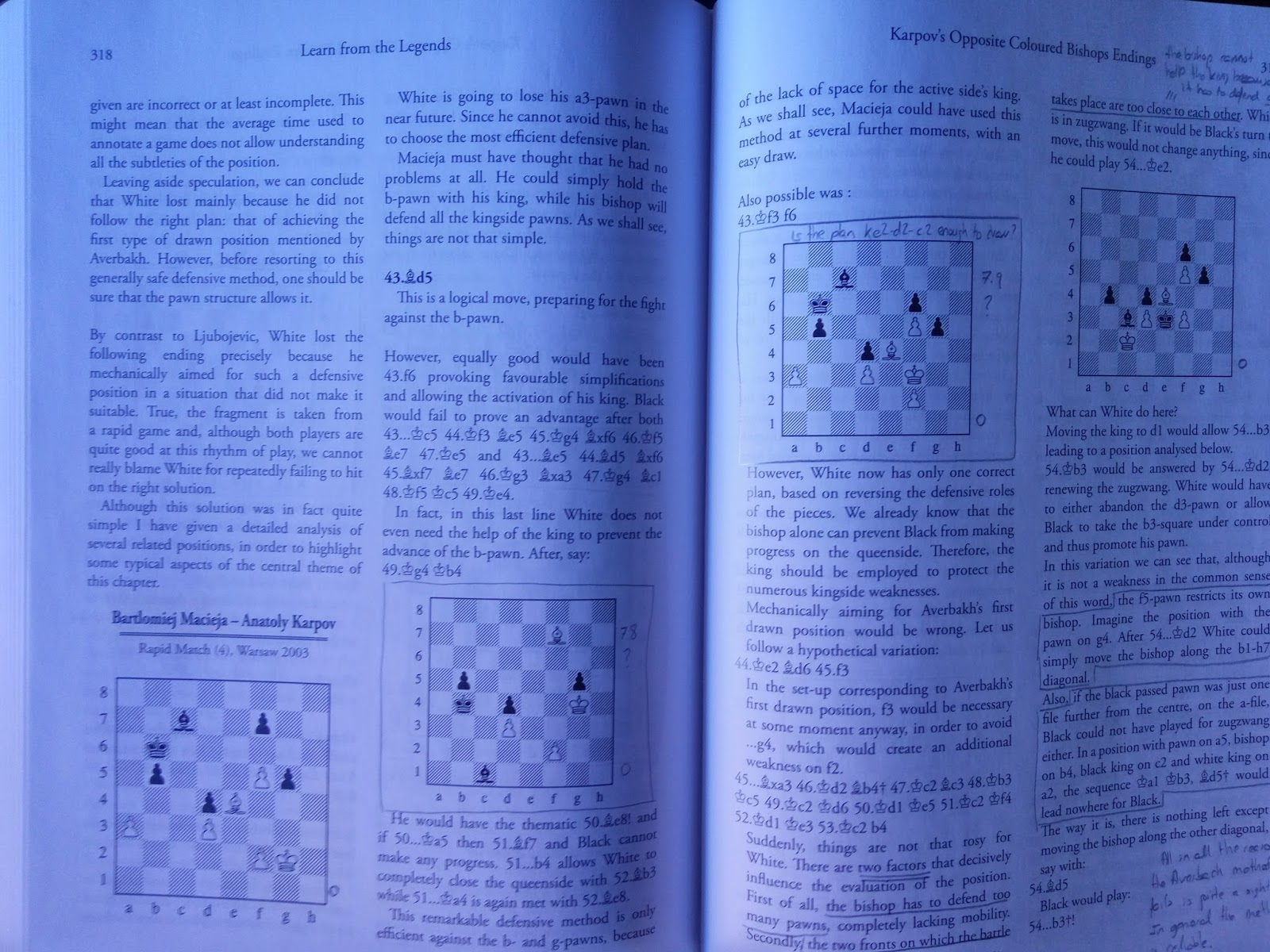
This is usually one of those books people praise to no end while I'm quite unimpressed. You have to put a very strong will to study the material as it is very easy to just read and nod. In this book I tried hard not to do that and I went on studying the diagrams trying to decide on the next move. If I found the next move could be posed into an exercise (it was Dvoretsky and his little '?' marks in some diagrams who inspired me to do that) I would mark the diagram as an exercise (so next time I read the book I can train myself better). The final product looks like this:


In that chapter, for example, I found 39 exercises. I am too lazy to go through each chapter counting the exercises I found, but one may assume it is more than two hundred.

Taking advantage of the picture above I can say the edition is pretty good (at least in hardcover). As you see, the book lies flat on his own, something very useful when you are studying the material. I have already praised enough this publisher hardcovers, so there is nothing else to add.

The length of the book, at near 500 pages, is really great. You cannot really ask for more. And this extra size does not translate in an increasing price, which is good. It cost as much as the usual QC stuff.

Marin's style of writing is pretty good and insightful. While reading it I was able to understand why so many people claim this book to be one of the modern classics. Marin does not mince words and explains what is going on quite well.

However I was troubled with the analysis. There are three things I want to point out:

  • Big statements: Marin is big on saying: this position is winning. You fire the engine and he does not agree (at least not in my phone). It offers a line for the defending side and Marin does not talk about it. I understand that engines' opinion in endings have to be taken with a grain of salt as it is easy they have not reached enough depth. On the other hand, if I had doubts about the big statement and find the line of the engine convincing, what am I to do? Maybe the engine is wrong, but the analysis is at least incomplete and the reader is left with doubts.

    Personally I feel that this statements most of the times are clear exaggerations. However it forced me to check the text with an engine as I never trusted Marin again. And I was not that impressed in some instances (more than a simple check with a modern computer would allow).
  • Dissonant commentaries: If you read the book you will find Malfagia contributed heavily to the analysis. He is the italian translator and found a number of troublesome variations. In the second edition corrections to the text were made based on his and other people commentaries. In the third edition the text was corrected again (I cannot say if as heavily as in the second edition as I do not have anything to compare. Incidentally I think the mistakes I found were in those positions nobody else cared to look at). Unfortunately nobody read the whole text again and you may find contradicting statements where for example Marin says White is winning but then the variations afterward show a draw. It did not happen that much, but when it did happen it created distrust. I would say that you may find around ten instances of such thing in the whole book. It is not too much for a book that big, but it really bothered me.

    In that vein there is one very painful example: The game Karpov - Kasparov (Wch 9) Moscow 1984 has seen its analysis heavily edited each time. The ending is really difficult. It is hard to follow, but then when the text does not flow coherently as many edits have been made in the middle of the game it is a lot worse. At some point I had no idea if the position was winning or not, nor which was Marin's recommendation.
  • Uneven level of detail: There are games studied to painful depth (Karpov-Kasparov is one example). I doubt anybody except the most adherent fan of endings using silicon help would find those extreme cases interesting. You simply get lost in the details. You may find some interesting positions along the way, which I imagine is why Marin left the analysis there, but the rabbit hole went really really deep.

    On the other hand there are games with a very superficial analysis (and some are the infamous 'White is winning' from the first point). 

    I would have liked that the excessive details in some games were left out and all the examples were given its fair share.
Another thing I would like to point out that I did not like is that there are Marin's games. There are not many, but in some chapters they are a lot more visible. My guess is that the process of making the book is at fault here. It seems it was conceived as some articles on great players and then put together (that may explain the unevenness of the analysis). So in some chapter he may have wanted to compare his play with that of the great champion. But I as a reader would rather get a champion playing. It does not need to be the one featured in that chapter, mind you, but at least a world championship contender...

On the whole I have a very mixed feelings about this book. I liked reading it, I found it interesting and I am sure at all levels you will find something to learn too. As it is pretty lengthy, you can simply skip the analysis when Marin loses his head in the maze of variations and ignore the light analysis (mind you, it may be at Shereshevsky's Endgame Strategy level, but for me that is just not enough at this age) and you are still left with a lot of content.

On the other hand, the lazy analysis and the confuse text in some parts killed my joy.

So I recommend the book with some caveats. For my part I will read it again to take advantage of the exercises I found.

lunes, 13 de marzo de 2017

Review: Maneuvering: The art of piece play by Dvoretsky


Title: Maneuvering: The art of piece play.
Author: Mark Dvoretsky.
Publisher: Russell Enterprises.
Year: 2016.
Pages: 212.
Price: Around 25€.

I assume everybody reading this knows Dvoretsky fairly well. He was one of the best trainers of his time and a great author too. His books were usually aimed at an unusually high level and gained high praise.

Personally I have never been a great fan of his work (except for Endgame Manual). I am lazy and tend not to think too much while reading a book and Dvoretsky's book usually had to be read slowly and making conscious effort.

However his last two works, Recognizing your Opponents Resources and Maneuvering The Art of Piece Play are not his usual kind. They are exercise books like the ones of Aagaard. I like this two books a lot more than his previous work. It is much harder to be lazy when all you have to do is solve exercises.

In this review I will talk about the second one, Maneuvering The Art of Piece Play. While many things may hold true for Recognizing your Opponents Resource too, when (and if) I finish it, I will review it as well.

The book is divided into an introductory chapter without exercises and then ten chapters with exercises to solve. This ten chapters cover opening, middle game positions and endings.

In total there are 228 exercises. However Dvoretsky liked to put additional exercises in his texts (traditionally he did this in his normal works, and he kept it for this book too). Those additional exercises are diagrams marked with the '?' mark on them. There are 128 of those exercises, so we will do best to think of this book as containing around 350 exercises.

The basic point of the book is to teach you to maneuver your pieces. This usually consist of making two or three moves in a row with the same piece until it reaches its perfect square. The main exercises (the ones marked as such) do focus on this. On the other hand, the 128 additional exercises mix things up and can be about anything.

Generally I was satisfied by the solutions, but you do need to keep in mind that this are positional exercises so they tend not to be clear cut. The solution usually contains a large part of the game under consideration (along with some additional exercises if the position merits it) while you are only expected to find the bold moves at the beginning. The idea is to give you a feeling of how the position evolves after the intended solution. While I like the idea behind it, the truth is that I would usually skip this part fast.

The edition of the book is fine. There is only paperback available, while I would have loved a hardcover. The quality of the paper is not bad by any means, but if you compare it with a Quality Chess edition it loses.

One thing I specially dislike about the edition of the book is that it is hard to not spoil yourself the solution of the 128 additional exercises. They are in the middle of the text marked only by a little '?' sign. It is quite easy to miss them. I went through the whole book marking them visibly so I would be aware of them with just a glance and could hide them with a paper. However this solution is not ideal either as it is quite annoying. More than once I placed the paper badly so I spoiled the solution anyway.

I think the book is short and there is no discount for this, but it does contain around 350 exercises. At 7 cents the exercise you cannot reasonably call it expensive. Compared to Positional play from Aagaard (this is the more similar book I have read), it has more exercises, but it is shorter, so the explanations can't be as thorough. While reading it, though, it never crossed my mind that some solution was not given enough attention. Sometimes numbers are deceitful like this.

Overall the level of the book is difficult to judge for me. I got around 50% of each chapter right (but there were chapters were I did better than others), but I think I spent less time than with other books per position. While solving this positions you enter a state of mind were you only care about maneuvering, which is good because it is what you are training after all, but limits your approach to the position heavily. If you find an interesting move which is not aimed at improving a piece through various moves, then you simply discard this move. If you find a pawn lever that might be good, you discard it too. In this way the positions felt easier, many moves can be discarded through this process.

In conclusion, I recommend this book unambiguously. I do not think you need to be specially strong to enjoy it (but if you are not that strong, prepare to be frustrated by the exercises at the end of each chapter). The solutions are short and easy to understand when you see them and it is likely the first time you encounter problems similar to this one, so it is a very good book to complete your bookshelf.

domingo, 1 de enero de 2017

GM Preparation - Attack & Defence by Aagaard


Title: Grandmaster Preparation - Attack & Defence.
Author: Jacob Aagaard.
Publisher: Quality Chess.
Year: 2014.
Pages: 304.
Price: 24.99€ (paperback) - 29.99€ (hardcover).

This book is a part of a 6 title collection. Each one deals with a specific topic through some introductory prose and tons of exercises. The objective is to give people aspiring to be Grand Masters (or already GMs wanting to stay sharp) training material. The one being reviewed is centered in attack and defence.

In order not to shamelessly copy my post on 'positional play' I am going to assume you have read it. Almost all the things I state there are valid here too, so I may only point out what is different. Be aware of it!

This is a workbook too (which, as said in the other post, I'm in love with) and is divided into 13 chapters, 8 on attack, 4 on defence and the last one mixed. In theory this is the companion book of Attacking Manual I  so the content of the attacking chapters comprise the subjects studied there except for a new one called the Kill Zone (basically you have to keep the king trapped on the mating net, not let him fly away). The chapters on defence are not derived from Attacking Manual I but can be found elsewhere in Aagaard's word. They are Only Move, Comparison, Prophylaxis and Active Defence.

In total there are 309 exercises in this book more or less evenly distributed between chapters.

In this book the thematic division is a lot more clear than that in Positional Play, which may help you a lot when solving your exercises. For example in the first chapter, Include all the pieces in the attack, you know you have to find something to include a piece, in Kill Zone, you have to stop the king from fleeing, etc. Rarely does the exercises feel alien to a chapter.

As in the other GM Preparation books, the exercises are computer-checked. In Positional Play it may came down to opinion which was the best move, and you may not agree with the author. Here the solution is clearly the strongest move, even if in some random exercise it does not feel so reading the solution. If you let the engine run it will agree.

The only problem I had when working my way out with the book is that my solutions were not studied so I did not know why I was wrong. But of course it is impossible to have all the possible moves in the solutions, so no point complaining there (although if these books were on Forward Chess you would have the engine at a tip of your finger).

The edition of the book is great, as is to be expected from this publisher. I own the hardback, which can lay flat on a table while you are studying, and would not recommend to go paperback. You pay 5 more €, but it is so much easier to work with the book! And with a book that you should be revisiting often, why are you going to be cheap?

In Positional Play review i talked about the time / money metric I often use to value a book. This book is even better, as not only it has more exercises, you will usually spend more time on each of them. At 10 cents a problem (in hardback) and 60 cents an hour of entertainment, I do not think you can find much better deals...

In my last review I said I do not think Positional Play is for IMs and GM, but to an audience a notch lower than that. I based my opinion on the fact that I, at 2200, could be able to solve half the problems. Hence my opinion is that at 2200 you stand to get the best results from the book.

This continues to be true in this book to a certain extend. The attack chapters have me always around 50% while the defence chapters and the last one totally destroyed me (Chapter 9: 8/28, Chapter 10: 5.5/9, Chapter 11: 5.5/17, Chapter 12: 10.5/33, Chapter 13: 17/54). So half the book is okay at my level but the other half is harder (or maybe I'm just weak defending). I must admit though that I have always been a positional player, and this attacking thing is new to me.

In this book you can notice how the exercises are increasingly more difficult as you advance in the chapter as in Quality Chess Puzzle Book. In long chapters it is mentally very challenging as you know you have a lot of failing ahead of you when you start experiencing difficulties.

My advice there is that you have to be able to skip a chapter when you see you are in utter misery while solving exercises, but be aware that improving is suffering, hence you have to force yourself to a certain extend, not get demoralized and give up. I think I may have given up mentally at times, but not skipped an exercise.

In order to get a feeling what are you getting into, go download the excerpt and  see how do you fare. Of the 6 exercises there I made 2 correctly and one so-so (2.5/6). I recommend this book if you feel that you are strong enough to handle it (although expect a world of pain), otherwise, go the Yusupov way!

martes, 4 de octubre de 2016

Nothing related to chess

A friend of mind is trying to get her  blog accessible and google keeps ignoring it, so maybe with a link google's spiders will find it easier:


Eleni Papachristou


sábado, 30 de julio de 2016

Review: The Quality Chess Puzzle Book by Shaw


Title: The Quality Chess Puzzle Book.
Author: John Shaw.
Publisher: Quality Chess.
Year: 2010.
Pages: 354.
Price: 23,99€.

I have never been a fan of books on tactical puzzles. I do not know the reason, it could be that I find tactics beneath me (I like to win games on solid positional ground, not on the seemingly random tactical skirmish), or maybe it is that puzzle books force you to really study them, you cannot read the book without effort. It could also be that as tactics is not my strong suit, I try to avoid it as to not threaten my self-steem.

Anyway only recently I took a liking on solving tactical puzzles. Two years ago I read Weteschnik's book on tactics and found it a very positive experience, but other than that, the other books I took interest in were not about tactics.

John Shaw's Quality Chess Puzzle Book is, as you may deduce by its tittle, a book of tactical exercises. It has been a collaborative effort of the publisher (I seem to recall that Aagaard provided the exercises for Shaw to choose from, and Shaw chose them and wrote the prose of the book).

As a disclaimer, I must admit that I have not studied the whole book, but studied the first 512 exercises (around 70% of it).

Unlike traditional puzzle books, this one is not organized by theme, nor it is organized by difficulty. It contains 15 chapters on random themes. For example there is a chapter with some of Ivanchuk games, two other called Missed opportunities, etc. The point is that the themes make no sense from a purely chess perspective, so you will not be thinking about pins in this chapter and forks in the next one, because you will have no idea what to expect. Inside a chapter, the level of the exercises increases, but it lacks any scale to guide you on how difficult an exercise is.


The book contains 735 exercises (I remind you that I can only truly talk about the first 512 of them) plus at the beginning of each chapter there is a short introduction with some more games (which I did not care enough to study and do not think you would miss anything by ignoring it either).

The edition I own is the paperback one and I am quite happy with it (usual Quality Chess). As this book will expend a lot of time in your hands, expect to wear it off fast. In my case, the cover is starting to suffer, but nothing plasticizing it would not solve.

I have developed a liking of hardcover books (which in this case is 6€ more expensive) and now I regret not having that edition instead. That is because it seems to me now that this book can be enjoyed in many years to come, and having a better edition makes sense, as 20 years from now would be good as new. But do not let my snobism affect you.

At 735 exercises the book is huge. Each exercise costs you less than 3 cents of an €.


I have a little guide to make these reviews, and one concept I review is the prose. As this is a puzzle book, talking about how it is written makes little sense, but habits are good, and guides are good too. So the little prose the book has is good, sometimes Shaw makes jokes, and sometimes he tells you stories. I like it. But of course it is totally irrelevant for this type of book.

The analysis, as far as I have dared to oppose Shaw, is spot on. I do not think I have found any invalid problem. My only problem would be that sometimes my solution is not considered by the author, but who could blame him when it is clearly inferior to the proposed solution?

The book is a good book, no doubt about that. The first thing to check is that solutions are spot on, and that is the case. It could be better if it had more failed attempts, but nevertheless Shaw's failed attempts quite often agrees with me (and many times, with the player's choice in the game). The fact that the theme is random makes it more difficult. I do not know if it is good or bad, but I prefer it like that. In a real game you do not know the theme either.

One point I dislike of the book is that it has no indication of the level of the exercises. Normally this indications are just very rough approximations, but they are very useful.  Each chapter is increasing in difficulty but that is not something you may realize. At least for me it was not. There is a point that you would do better jumping to the next chapter than banging your head against unsolvable problems, and if you realized the exercises to come in the chapter were still harder, you would, but as it stands, you may not do it.

So, do I recommend the book?

I always find it tricky when the answer is not wholeheartedly. There is always many sides in the issue. So let me tell you a story first.

I own this book since 2015. I bought it at the same time as The secret life of bad bishops and Positional decision making. I solved 150 exercises relatively fast, and then put the book down, and only recently (in the last month) I surged through it, solving 350 more.

Why is that? Well, the exercises are difficult! I left the book when it was a pain to go through it, plain and simple.

Of course this is not Shaw's fault, but brings me to a very important point. It is my opinion that any kind of exercise book has to be the right level for you. If it is too easy, you most likely will not think hard enough to improve your chess (and when the exercises are difficult enough, you may be tempted to dismiss them with shallow solutions instead of delving into the subtleties of the problem). If the exercises are too much for you on the other hand, you most likely will put down the book as you will get demoralized.

It is getting repetitive by now, but I'm at 2200 elo points. I have been working hard on tactical puzzle this three months (with Aagaard's GM Preparation - Calculation and Dvoretsky's Recognizing Your Opponent's Resources -do not expect a review on those books soon, though, it will be a long time since I manage to finish enough of them to feel comfortable reviewing them). So my hope is that my tactical awareness has grown and I am now rated higher, but most probably this is only a wet dream of mine, because this things take longer to settle.

Anyway, as a 2200 player, spending unlimited time (between 5 and 10 minutes, but I do not time myself with this book) on the exercises makes me solve around 50% of them. The first on a chapter I solve faster and with no mistakes, while the last ones provoke me nightmares (I failed 9.5 out of the last 11 problems in chapter 8, 8 out of the last 11 problems in chapter 9, and 3.5 out of 5 in chapter 10). All in all, that is the right level for me, and seeing that the starts are easier and the endings are harder, it may be a good book for players rated 2000 elo points or above.

The endings of the chapters is what made me put down the book. I did not know that each chapter starts easy and then goes into mad levels of difficulty. On the contrary I thought that what was to come was even more difficult than what I have already studied, so what was the point in continuing with the book? Now that you are aware of this, please jump into the next chapter when you cannot solve any more exercises of the present one.

My last point before the conclusion is a monetary point. At five minutes per exercise (being on the cautious side, but you will not be solving all the exercises after all, so it is a good approximation), you will spend more than 60 hours with the book. At 24€, you are paying 1€ for each 2.5h of entertainment. I do not think anyone can make you a better deal than that.

So I recommend this book to players above 2000 elo points with some caveats. Do not try to solve all the exercises. Stop and go to the next chapter when you get stuck. You may find that you are comfortable with only half of the problems in the book. Well, more than 300 exercises are plenty!

If you have less than 2000 elo points, go with Weteschnik!

PS: I am reviewing the book while having not finishing it because I am suffering in chapter 12 already, chapter 13 seems to be easy (according to its introduction), but chapters 14 and 15 (starting with problem 558) seem to be hell. I do not look forward to the pain of solving them. So I have decided to move to another book on tactics :)

PS2: I started to make this reviews because it seemed to me that there was a lack of good reviews out there. I bought books based on good reviews that greatly disappointed me. I think that is because the reviews were based on a very quick reading of the book. If I had reviewed this book in 2015 when I put it down, I would have said that it is a great book but with a very high level, while now I think it is just a little bit more difficult that what I'm comfortable with. So yes, I was right, quick reviews do not cut it.

lunes, 18 de julio de 2016

Review: The Attacking Manual 1 2nd edition by Aagaard


Title: The Attacking Manual 1 2nd edition.
Author: Jacob Aagaard.
Publisher: Quality Chess.
Year: 2010.
Pages: 320.
Price: 29.99€ (paperback).

The attacking Manual 1 is a book in which, according to the introduction, Jacob Aagaard has spent a lot of years of his life. The book tries to explain how attacks are conceived more than executed, which is kind of different from other books on attack (see for example Gormally's Mating the Castled King).

From this perspective, the book delves into seven concepts of attacking play (the Contents page is confusing, hence I translate it):

  • Bring all your Toys to the Nursery Party: You should attack with all your pieces
  • Don’t lose your Breath: Attack as fast as possible.
  • Add some Colour to your Play: Weakness in a colour complex.
  • Size Matters!: The quantity of the units attacking is also important, not only the quality.
  • Hit ’em where it hurts: Attack the weak points.
  • Chewing on Granite: Attack the strong points so you gain access to the weak points.
  • Evolution/Revolution: While attacking, be mindful that you may stop, gather strength (evolution) and then go at it again (revolution).
Apart from that, there are 15 attacking games commented and a last chapter with 50 exercises to solve.

Normally I am quite pleased with the quality of QualityChess products, but I must admit that this one is subpar, there are some mistakes in the text and in the diagrams, certainly more than usual. This point is even worse when you think it is a second edition, where this things should have been already solved. Other than that, this is a lengthy book at 320 pages.

The book is very well written (if you disregard the problems with the edition) and very appealing, typical of Aagaard's style, similar to those books he wrote for Everyman. The ideas exposed are often very well known, only adding to the known themes new examples. However, it has a chapter on Evolution/Revolution which really made an impact on me. The concept is that when you are attacking, you evolve your position until the point where you cannot evolve it any longer by normal means, and you start sacrificing (revolution). Afterwards, however, you do not need to continue the attack like a mad man, you may stop it to bring reinforcements (evolution). I had never seen this concept anywhere else and found it very interesting.

Aagaard tried in this book not to suffocate you with variations, striving to offer only the key variations of the position. I think he has not succeed at all. A lot of times I found myself having to start the engine to show me why the position was in fact winning and not only complex, while other times I was following 10 moves long variations which made no sense to me (surely proposed by the computer) for no apparent reason. In those moments, even if there was a reason, the fact that I did not get it is a flaw.

All in all the book is interesting. Its reading is easy and interesting, and you may very well read it quite fast. The analysis may not be the most on point I have ever seen, but it is not bad, just not great.

The main problem I find with this book is how easy is to read it and do not assimilate anything. Normally you would be reading quite an interesting paragraph just to be distracted by some game. You would want to finish it as fast as possible to be able to continue with the reasoning. When you realize it, you have finished the book and have learned nothing. I must admit that it is wrong to transfer my personal flaws to the rest of the chess aficionados,  but if you are like me, you know you need to make a lot of effort to stop and think instead of read and nod.

Personally I liked Gormally's book better, it is cheaper (this book is very expensive, costing 5€ more than its peers at the same publisher) at the same length, it requires more or less the same level from you, it has better analysis (this is: deep when it needs to be, shallow elsewhere), and it has a lot more exercises, which is what gets me going. So I would only recommend this book to you if you have already Gormally's book, and with the strong caveat that to really profit from this book you should have to put the extra effort.

PS: I solved the 50 exercises with 10 minutes for each position, working an hour straight in a batch of 6 exercises. With that conditions I was solving a little bit more than half of them (at 2200 fide strength), while with 5 minutes for position I was getting destroyed.

viernes, 1 de abril de 2016

Review: Build up your Chess by Yusupov


Title: Build up your chess.
Author: Artur Yusupov.
Publisher: Quality Chess.
Year: 2008.
Pages: 264.
Price: 23.99€ paperback.


In this review I want to talk about Yusupov's series in Quality Chess. I have chosen to portrait the first book on the series but it would generally be applicable to every book, not just this one.

Another important caveat I want to make is that I have read the first two books and the last exercises from the last book.

This series of books is an acclaimed collection of exercise books. It has come to my attention that Yusupov has made another book to complement the series which I'm reviewing and Quality Chess is going to publish it in english (if you speak german, you are lucky, because I think it has already been published there). So now that Yusupov's books are again on the spotlight it seems only natural to fill this horrible gap in my blog :)

There are nine books in the series, grouped in three colors (orange, blue and green), named 'build up`your chess', 'boost your chess',  and 'chess evolution'. You are supposed to read each color in this order.

Each of the books is divided into 24 chapters and a final test. Each chapter has an introduction of the chapter, which spans around four pages, and twelve exercises. The exercises have points of difficulty which are rewarded if you have seen some key moves of the solution. You can add up all the points to score your final evaluation of the unit. It may be that you have done excellently down to you have to repeat the unit.

The final test has only exercises which encompass everything studied in the book, and there are 24 of them.

The books aim to give you a solid base in every aspect of the game, so you are going to study some openings (really it is almost only exercises, so not heavy theory there), tactics, strategy and endings. As each chapter delves in a particular subject, you are not going to get bored easily, which is great for someone like me that likes to read various books at once just to change the pace.

All in all you are getting 312 exercises in every aspect of the game. At a standard lenght of 264 pages, you can hardly ask for more, but GM Preparation series are thicker, hence pack more exercises. Maybe compared to them or some other books 312 does not seem much, but I never felt that there were few problems, it just felt right, so no complains there.

The level of the exercises is high enough so that me (at 2200) went through the first two books fast and steady, but always felt I was challenged. As I see it, anyone starting from 1700 can enjoy the books.  Players lower than that should however download the excerpt of the first one and see for themselves, because it includes a complete chapter.

I like exercise books a lot, so I do not care much that the prose is sparse. What do you expect after all? For me the prelude of every chapter before the exercise was something to go through as fast as possible, but the official stand is to study it carefully and spend at least an hour on it. I cannot say it worked much for me as I already knew the subjects discussed, but it is there, so maybe it is profitable for you.

The quality of the solutions for me it is the worst part of the series. It happened to me a lot (a lot maybe is twice per chapter maximum) that exercises that I failed to solve had a flawed solution. Those normally (maybe exclusively) would come from positional exercises.  In those exercises a solution was put forward, but the machine would regard other moves as equal or better than the one recommended.

Positional exercises are the most difficult ones, I know, and the machine likes some lines which may be ok but Yusupov tries to show you the easiest path. But in this kind of case, I need from the author the statement that other moves are possible (and list them) but the one in the solution is the one he likes and reason it, otherwise, I would rather believe the machine at 3300 elo than Yusupov at 2700.

All in all, however, I think this series of books is pretty good. Maybe some solutions are not on the spot, but I have not seen anything so comprehensive in the market in any other place. Hence I recommend the series to anyone from 1700 to 2200. Those below 1700, I would recommend to try their hand at the excerpt. If they feel that hitting a brick wall while doing it, then go for something more elementary,. Those with more than 2200 will certainly pick some things here and there. There are challenging exercises and you will have to put a lot of work. But 9 books is a lot of money invested, so maybe you can go directly to the blue series.

As a testament of the difficulty of the books, I have some anecdotal evidence. A friend of mine and me, both at 2200, got a hold on the last book, and made the final test. We allowed us 2h for the whole thing (so 5 minutes per exercise). We both failed to pass the test narrowly.